Spencer Lee
Computational Mathematics
Scientific Software
Quantum Optimal Control
About Me
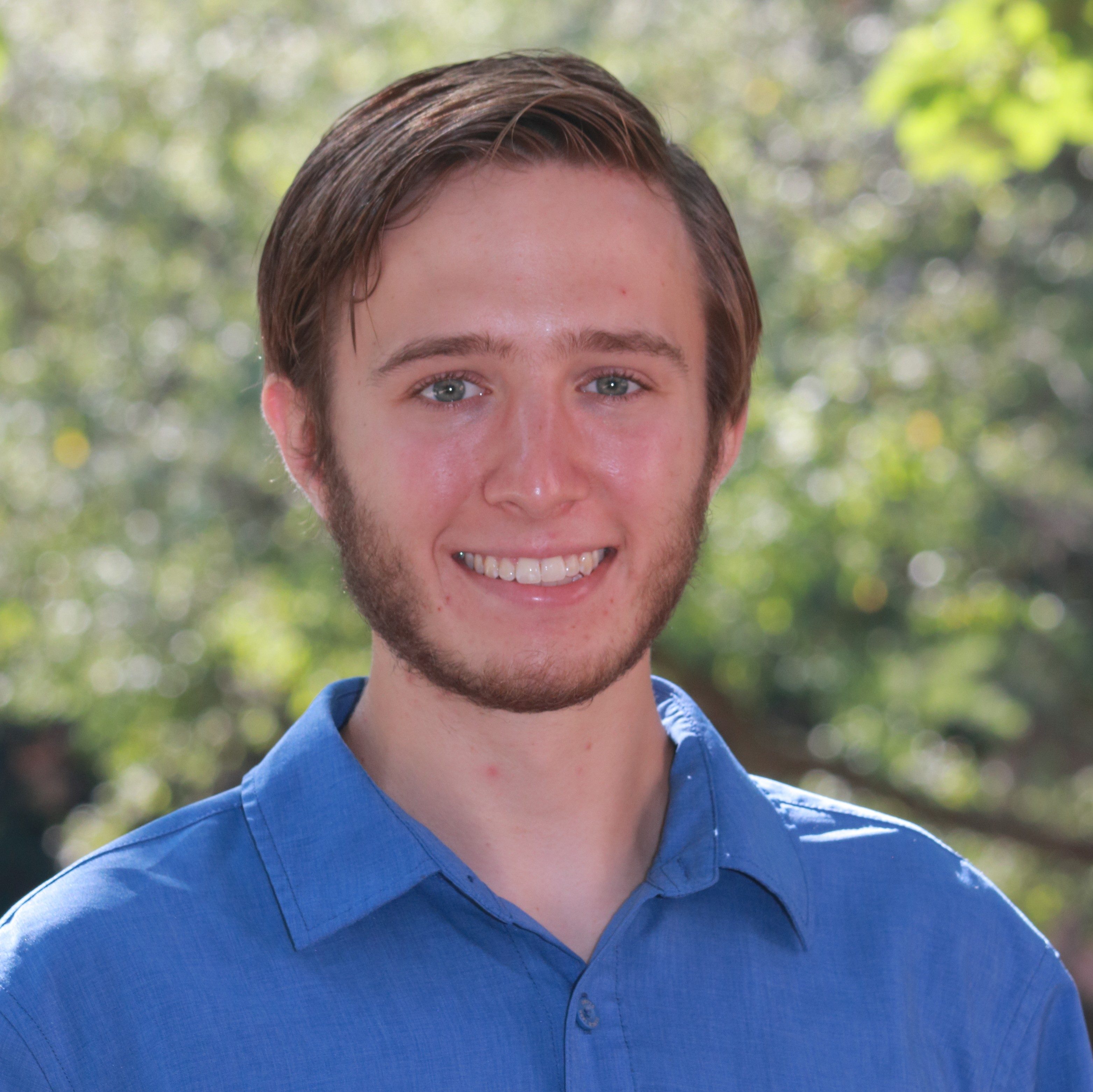 I develop high-performance numerical methods and scientific software for quantum optimal control and other cutting-edge scientific problems. I am a PhD candidate in Computational Mathematics, Science, and Engineering at Michigan State University, and I am the developer of the open-source Julia package QuantumGateDesign.jl, which quickly solves quantum optimal control problems using a novel, high-order numerical method based on Hermite interpolation. You can read about the method in our publication in Journal of Computational Physics (or in the arXiv preprint).
I am looking for a job after I graduate! If you are looking for someone with experience in writing high-performance software for physics simulations, especially for quantum optimal control, please email me at leespen1@msu.edu, or contact me on LinkedIn.
About Quantum Optimal Control
In quantum computing, algorithms are often written as quantum circuits. The following quantum circuit takes two qubits in the ground state () as inputs, and outputs the maximally entangled Bell state .
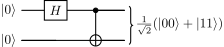
The squares and circles in the diagram are quantum logic gates, which are the building blocks of quantum algorithms. The behavior of a quantum logic gate is defined by how it affects the possible inputs of the gate. For example, the Hadamard gate is defined by the following input-output maps in the following table.
| Input State | Output State |
|---|---|
Quantum circuit diagrams abstract away the physics and engineering work required to implement a quantum algorithm using real hardware. It is assumed that we can do operations like "apply a Hadamard gate to qubit 1", or "apply a CNOT gate on qubits 1 and 2."
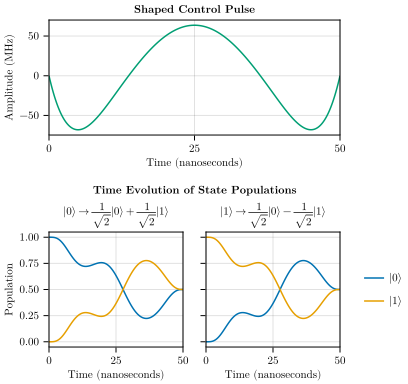
To implement a quantum logic gate on real quantum computing hardware, we control the amplitude of electromagnetic pulses to manipulate the quantum system. This is called pulse-shaping, since we control the "shape" of the pulse when plotting amplitude vs time.
For example, consider a qubit whose Hamiltonian is
where is the amplitude of an electromagnetic pulse which we control. [In the computational basis, where and , the matrix forms of the operators are .] Using numerical simulation and optimization, I found that the following control pulse implements a Hadamard gate very accurately.
We can also design multi-qubit gates, like a Controlled NOT gate. [This is represented by the dot and circle in the same column in the Bell state preparation circuit diagram.] For each qubit we add, the size of the numerical representation of the system doubles, which makes simulating the system more computationally expensive. In addition, depending on the Hamiltonian of a given quantum system, the system may have very "fast" dynamics which are computationally expensive to simulate. Moreover, the parameters of an individual quantum system tend to drift over time, so that the control pulses must be recalibrated on a regular basis
My work focuses on novel methods to accelerate the simulation of the quantum system (while still keeping some properties which are necessary for efficiently optimizing the pulse shape) so that we can efficiently design and recalibrate pulse shapes to implement accurate, multi-qubit gates.